kkvictorylap

Saturday, May 16, 2015

Cambridge, Ely in Cambridgeshire and Sudbury in Suffolk, England


Friday, I drove from Colchester to Cambridge, Cambridgeshire, England, mainly to see the University of Cambridge, but also the town and surrounding area.  The Universities of Oxford and Cambridge are made up of many Colleges.  There is really no main campus, but the Colleges are spread out all over town.  Both towns are very old and quaint.  Cambridge was beautiful!  Here are some of the Colleges I saw in Cambridge:

Emmanuel College 


Pembroke College


Peterhouse College


Entrance and building for King's College


 Christ's College 

Corpus Christi College

After I left Cambridge, I went to Anglesey Abbey in Lode, just NE of Cambridge. AA used to be an Augustinian priory for monks during the reign of Henry I.  After the Dissolution of the Monasteries in 1536, they were expelled and it became a private home.  It now belongs to the National Trust of England.
 Anglesey Abbey

Near Cambridge, is a small town named Ely.  It is famous for its beautiful cathedral.  


Ely Cathedral

I saw these precious little duckies outside of the cathedral!


Also in Ely, is the home of Oliver Cromwell.  He is best known as Lord Protector of the England, Scotland and Ireland in the mid 1600's.  He was an intensely religious man and became an independent puritan.


Oliver Cromwell House

 I stopped to see Kentwell Hall also listed on the National Trust Register.  Kentwood Hall is a stately home in Long Melford, Suffolk, England.  It was built in the mid 16th century and was occupied by many generations of the Clopton family


Kentwell Hall

Just next to Kentwell Hall were these adorable homes!


Across the lane from these homes and Kentwell Hall was Melford Hall, the ancestral seat of the Parker Baronets.  Beatrix Potter was a relative to the Parkers and was a frequent visitor at Melford Hall.


Melford Hall


Saturday, I drove the Mersea Island, (pronounced Mercy).  It is an island in Essex in the Blackwater and Colne estuaries southeast of Colchester.  The island is split into two main areas, West Mersea and East Mersea and connected to the mainland by The Strood, a causeway that floods at high tide.  Mersea has been inhabited since pre-Roman times and was a holiday destination for people who lived in Colchester.  A church on the island is thought to have existed since the 7th century.  From the 16th to the 19th century, the island became popular with smugglers.  It was also a focal point for troops in WWI and WWII and observation posts are still on the island.

I tried to get there around high tide so I could see the causeway flood.  The water came up over the road, but it didn't flood.  My hostess said that people have been stuck on the island for hours because of high tide.  When I was leaving about 3:00, there was no water even near the bridge, in fact it was just wet mud!


 Mersea Island


The Strood, causeway to Mersea Island at high tide


Yacht Club

Home (I want) on the island

I ran into some pirates on the island!  Arrrrrrghhhhh!

 Huts for rent


I ate lunch at Mersea Oyster Bar

Back in Colchester near my B&B I walked to the Priory.  St. Botolph's Priory was the first and leading Augustinian convent in England until its dissolution in 1536.


St. Botolph's Priory

Thursday, May 14, 2015

Colchester, an Historic Town in Essex England and My Visit to Charles Dickens


I chose the town of Colchester because it is east of London and there are a few things I want to see here.  I will only be here a few days.  I am staying in a B&B hosted by Sara and her very old townhouse is right in the city center by an old priory ruin.  I got here late in the afternoon and stayed in for the night, except for walking into the town centre for dinner.

Wednesday, I didn't go anywhere by car.....I was tired of driving.  The UK highway system is interesting.  Besides driving on the opposite side of the road and driving on the opposite side of the car, it takes so long to get anywhere.  My destination might be 35 miles, but it might take an hour.  If you aren't on the main highways, the M's (M1, M25, etc.), you are driving in the countryside.  It's beautiful, but it takes so long to get anywhere.  The highway infrastructure is lacking....maybe they like it that way!  Anyway, I stayed in and washed clothes and got caught up on other things I needed to do. Because Sara lives in the town centre, I have to pay to park....expensive!

Thursday, I went to the area of Kent where Charles Dickens lived and did most of his writing; Chatham, Rochester, Gillingham and Higham.  In Rochester, I bought a map that took me on a walk around the city marked with important buildings in his literature.

Six Poor Travellers' House, 'a clean white house, of a staid and venerable air, with a queer old door.'  The Seven Poor Travellers....a short story by Dickens, in which Dickens himself, as narrator, became the seventh traveller.


 Six Poor Travellers House

Eastgate House, 'Seminary for young ladies, Miss Twinkleton.'  This Elizabethan mansion dates from 1590 and is featured in The Mystery of Edwin Drood as the Nuns' House, a school for young ladies and as Westgate House in The Pickwick Papers.


Eastgate House

Mister Pumblechook's House, '...eminently convenient and commodious premises'.  It is featured in Great Expectations as Mr. Pumblechook's House where he carried on business as a corn chandler, and again in The Mystery of Edwin Drood as the offices of Mr. Sapsea, an auctioneer.


Mister Pumblechook's House

Restoration House, '...I began to understand that everything in the room had stopped, like the watch and the clock, a long time ago..'  In Great ExpectationsDickens renamed the house, home to Miss Havisham, 'Satis House', borrowing the name from a real house near the castle.  Charles II stayed there on his return to England to be crowned.


Restoration House

The Vines, '...the nooks and ruins where the monks had once had their refectories and gardens.'  It is now a public park and was the vineyard of Rochester Cathedral and featured in The Mystery of Edwin Drood as the Monks' Vineyard and the route taken by Pip in Great Expectations when visiting Miss Havisham.  Dickens was seen there just two days before he died.


The Vines

Minor Canon Row, featured in The Mystery of Edwin Drood, these are 18th century houses built to accommodate the minor canons and the organist of the church.


Minor Canon Row

Rochester Cathedral, '...it's like looking down the throat of Old Time..'  The cathedral which is the second oldest in the country and dates from 604, is featured in The Pickwick Papers and takes center-stage in The Mystery of Edwin Drood, with the plot revolving around the ancient church and the people who worked there.


Rochester Cathedral

Rochester Castle, 'Magnificent ruin!....What a study for an antiquarian!'  This Norman castle at Rochester had a humbling effect upon Dickens, reminding him perhaps of his own mortality. 

Rochester Castle

The Royal Victoria & Bull Hotel, 'Good house - nice beds'.  Unusually for Dickens, he used the real name of The Bull Hotel in The Pickwick Papers.  Dickens himself stayed here at one time.  It is also featured in Great Expectations, as The Blue Boar.  It acquired the 'Royal Victoria' following an overnight stop by the Princess Victoria in 1836.

The Royal Victoria & Bull Hotel

The Guildhall, 'The hall was a queer place, I thought, with higher pews in it than a church'.  It was here that Pip was brought by Mr. Pumblechook, in Great Expectations, to be bound over as an apprentice to Joe Gargery.


The Guildhall

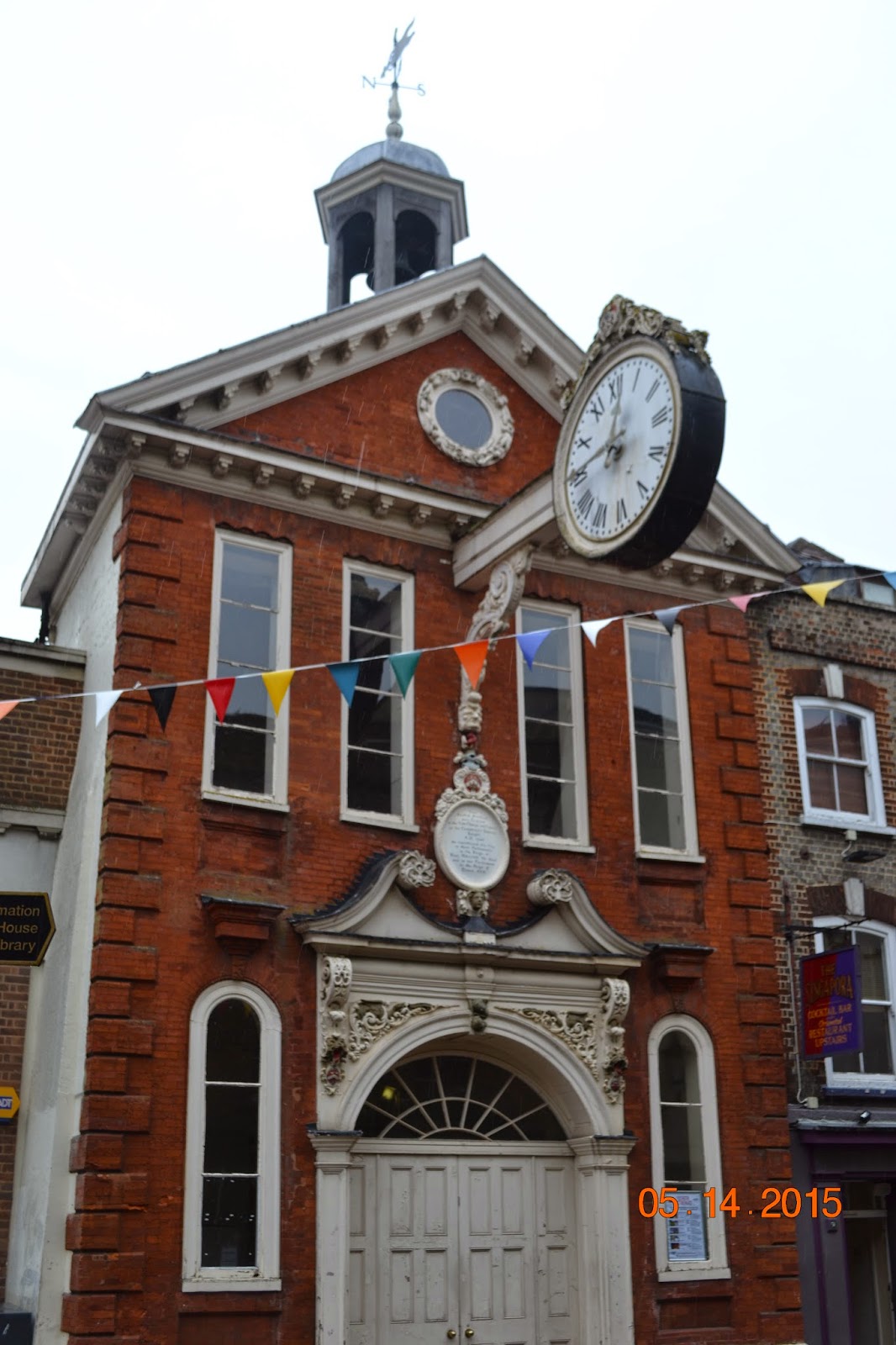
The Old Corn Exchange, '....oddly garnished with a queer old clock that projects over the pavement....as if Time carried on business there, and hung out his sign.'  The Old Corn Exchange was built in 1706 and is featured in The Uncommon Traveller and The Seven Poor Travellers.  It is said that Dickens loved to look at that clock as a boy.
The Old Corn Exchange

I drove to Chatham to see one of his boyhood homes.  He was born in Portsmouth, England, but lived in London and Chatham for a while as a child.  His father was in the Navy and they moved often.  


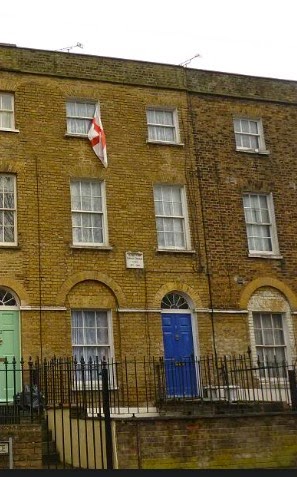
Left:  His home at No. 2 Ordinance Terrace

Right:  Plaque to commemorate Dickens


While walking as a boy with his father, he often passed Gad's Hill Place, three miles from Rochester in Higham   He hoped that one day he would own this fine, though comparatively plain 18th century house.  He realized his boyhood dream in 1856 when the house came up for sale and he spent the last 14 years of his life there.  This is a Wiki pic because the house is now a school and it was behind gates, walls and trees!  You can tell it's not mine because the sun is shining.....and it rained all day!  Dickens died at Gad's Hill Place on June 9, 1870 of a brain hemorrhage and is buried at Westminster Abbey.


Gad's Hill Place

Are you tired of Dickens yet?  Ha!  One more tidbit...like many novelists, he is believed to have 'borrowed' some of the names for his characters from headstones in local graveyards.  One such example can be seen in the small cemetery between the cathedral and St. Nicholas Church.  The headstone is a memorial to the Dorrett family, which may have served as the inspiration for his novel, Little Dorritt.


Dorrett Gravestone

It really was a fun day, in spite of all the rain....On my way out of town, I turned down a street to try to turn around and this was the name of the street.....


My mother's father was George Williams, her brother is George Williams, Jr.  His son is George Williams, III. and his grandson is George Williams IV.  And they grew up in a town very near Chatham, VA.....hmmmmmm!

Wednesday, May 13, 2015

Leaving Nottingham................


Well, this is Sunday and our last full day in Nottingham.  As if we haven't seen enough castles and country houses, we went to see Hardwick Hall.  HH is in Derbyshire and an Elizabethan country house.  It was built between 1590-1597 for the formidable Bess of Hardwick.  She was the richest woman in England after Queen Elizabeth I and her house was built to be a conspicuous statement of her wealth and power.  There is a tragic story about Bess's granddaughter, Arbella that was told throughout the house.  Check it out Arbella Stuart on Wikipedia.


 Front of Hardwick Hall


Left:  Silkscreen of Arbella Stuart
Right:  A room dedicated to document filing, about the size of a kitchen

 A Frieze on the wall of the drawing room
A guest bedroom


On our way home, we did a drive-by at Newstead Abbey.  We did not go in, but walked around the grounds and gardens.  It is in Nottinghamshire, very close to our B&B in Nottingham and was formerly an Augustinian priory.  It was converted to a domestic home following the dissolution of the monasteries by Henry III and it is best known as the ancestral home of Lord Byron, the English poet.

Newstead Abbey


It's Monday and Sharon and I are headed from Nottingham to Bletchley which is just NW of London.  Bletchley Park is in Milton Keynes, Buckinghamshire.  It was the central site of the UK's Government Code and Cypher School (GC&CS), which during WWII regularly penetrated the secret communications of the Axis Powers - most importantly the German Enigma and Lorenz ciphers.  The official historian of WWII British intelligence says that the intelligence produced at Bletchley shortened the war by 2-4 years and without it, the outcome of the war would have been uncertain.  It is now an educational and historical attraction celebrating those accomplishments.

Bletchley Park was amazing....forgot to mention....the film, "The Imitation Game", starring Benedict Cumberbatch was filmed at Bletchley.  He played Alan Turing who essentially invented and built one of the first computers to interpret the intelligence they gathered from Germany, Italy and Japan.
Movie poster

Cottages that the codebreakers lived in


The huts were numbered and each hut had its own function, then passed their work through passageways to the next hut


The 'Bombe' that Alan Turing built to decode and 
interpret secret messages from the enemy

On the way to Bletchley, we stopped in Leicester in the East Midlands in the county of Leicestershire.  In 2012, archeologists dug under a parking lot where an old church had once stood because they believed that this was where King Richard III was buried without recognition.  He was a very controversial King and was killed in battle, but his body was never found.  There is a King Richard III Society that pushed for an investigation and eventually this led to the dig......well, I'm not sure what the odds were, but they found his skeleton and were able to track down a descendant and, from mitochondrial DNA, determine the authenticity of the bones.  His re-interrment and service, complete with a parade and fanfare, etc., was just held in March of this year.  I had never heard this story, but my first B&B hostess told me about it and sent me a link to the story.  Check it out here King of the Car Park!

    
                       Leicester Cathedral          

Richard III's tomb

Posing with the King

Since we didn't have a B&B reserved, Sharon found an historic hall turned into a hotel for us to stay the night  It was Chicheley Hall, which is an ancient manor house that belonged to the Pagnell family but was given by them to the church.  Cardinal Wolsey gave it to Christ Church, Oxford, it reverted to the Crown and was eventually bought by a merchant....fast forward....now it is a hotel that specializes in weddings and conferences.  It was built between 1719 and 1723.

Chicheley Hall

Tuesday and I am dropping Sharon off at Heathrow Airport early afternoon and then make my way to Colchester in the county of Essex. I am sad to see Sharon go, but we have had a lot of fun and it was great to spend some time with her.